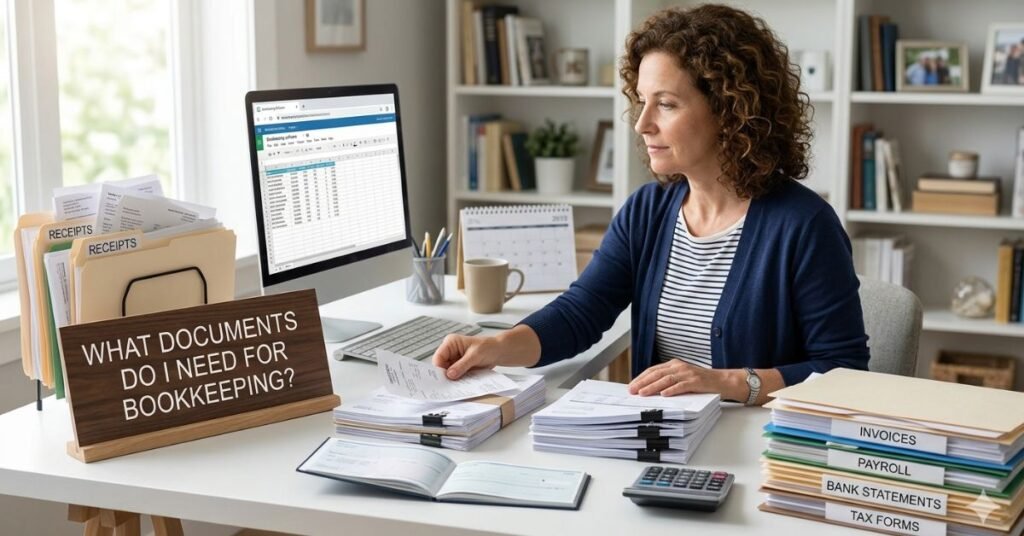
What Documents Do I Need for Bookkeeping? Complete Guide
Table of Contents
Imagine being audited by the IRS and realizing you threw away a box of receipts six months ago. Or applying for a business loan but having no organized financial statements because you lost bank statements. Every business transaction begins with a source document — the paper or digital trail that proves income, expenses, assets, and liabilities. Without these documents, your bookkeeping is guesswork, and tax deductions disappear.
In this guide, we list every document you need for complete, audit-proof bookkeeping. From sales invoices to credit card slips, contractor agreements to depreciation schedules, we cover it all. We'll also show you how long to keep each document (hint: it's not forever) and the best ways to store them digitally.
Whether you're a freelancer just starting or a growing ecommerce business, this checklist will transform your record-keeping. And if you need expert help organizing your documents, CashBook Accounting offers clean-up services and ongoing bookkeeping to keep everything in order.
Overwhelmed by Paperwork?
Let our team organize, digitize, and maintain your bookkeeping documents. Contact us for a free consultation.
📌 Why Source Documents Are the Backbone of Bookkeeping
Every journal entry in your books must be supported by a source document. These documents serve as legal proof of transactions, enabling you to:
- Claim deductions – The IRS requires receipts for expenses over $75 (and for all lodging).
- Defend against audits – Missing documents can lead to disallowed deductions and penalties.
- Secure financing – Lenders want to see organized financial records.
- Resolve disputes – Invoices and contracts protect you in client/vendor conflicts.
Below, we break down every document category.
💰 Income Documents: Sales, Invoices, and Revenue Proof
All money coming into your business must be tracked. Keep these documents for every sale or service:
| Document Type | Description | Key Information to Retain |
|---|---|---|
| Sales invoices / bills | Issued to customers for products/services | Date, amount, customer name, description, payment terms |
| Receipts / sales slips | Given at point of sale (cash or card) | Date, amount, items sold, tax collected |
| Credit card deposit slips | Summaries from payment processors (Stripe, Square, PayPal) | Settlement dates, fees deducted, net deposit |
| Bank deposit slips | For cash/check deposits | Date, amount, account number |
| Contracts / agreements | For recurring revenue or large projects | Terms, payment schedule, parties involved |
For ecommerce, also keep order confirmations, shipping records, and payment gateway reports. Our ecommerce bookkeeping services automate the collection of these documents.
🧾 Expense Documents: Receipts, Bills, and Vendor Records
To deduct business expenses, you need proof of payment and business purpose. Essential documents include:
- Vendor invoices and bills – For inventory, supplies, utilities, rent, subscriptions.
- Cash register receipts – For office supplies, meals (note business purpose on back).
- Credit card statements – Match each charge to a receipt.
- Travel & mileage logs – Date, destination, purpose, miles driven (use IRS standard mileage log).
- Asset purchase receipts – Equipment, computers, furniture (for depreciation).
- Loan agreements and interest statements.
Pro tip: Use receipt scanning apps (e.g., Expensify, Shoeboxed) to digitize paper receipts immediately.
🏦 Bank & Financial Account Statements
These documents are your primary source for reconciliation (learn more: Reconciliation in Bookkeeping). Keep the following:
| Statement Type | Frequency | Purpose |
|---|---|---|
| Business checking account | Monthly | Reconcile cash, catch errors/fraud |
| Business savings account | Monthly | Track reserves and interest |
| Credit card statements | Monthly | Verify expenses, separate personal vs. business |
| Loan statements | Monthly | Track principal vs. interest, escrow balances |
| Merchant account statements (PayPal, Stripe) | Monthly | Reconcile payment gateway fees and deposits |
👥 Payroll & Employee/Contractor Records
If you have employees or hire freelancers, these documents are critical for tax compliance:
- Payroll registers and timesheets
- Form W-4 (employee withholding) and I-9 verification
- Form 1099-NEC for independent contractors (if paid $600+)
- Payroll tax returns (Form 941, 940, state unemployment)
- Employee benefit records (health insurance, retirement plans)
Our payroll services automatically generate and store all required payroll documents.
📑 Tax Returns, Filings & Legal Documents
Keep copies of every tax return and supporting schedules for at least 7 years. Also retain:
- Annual federal and state tax returns (Form 1120, 1065, Schedule C, etc.)
- Quarterly estimated tax payment confirmations
- Sales tax returns and exemption certificates – more at sales tax services
- Business licenses, permits, and incorporation documents (LLC, Corp)
- Property tax assessments and depreciation schedules
Recommended Document Retention Periods (IRS & GAAP)
*Keep permanently: articles of incorporation, contracts, property records. For tax returns, keep 7 years after filing.
⏱️ Detailed Document Retention Guide
| Document Type | Retention Period | Reason |
|---|---|---|
| Bank statements, receipts for expenses | 7 years | IRS statute of limitations (generally 3-6 years, but 7 is safe) |
| Payroll records, W-2s, 1099s | 7 years | Employment tax audits can go back further |
| Asset purchase records (equipment, real estate) | 3 years after asset is disposed | To calculate gain/loss on sale |
| Tax returns and supporting docs | 7 years | IRS can audit up to 6 years for substantial omission |
| Corporate bylaws, stock records, contracts | Permanent | Legal and ownership proof |
💾 Digital vs. Paper: Best Practices for Document Storage
The IRS accepts digital copies of paper documents as long as they are clear, legible, and stored securely. Advantages of digital:
- Searchable – Find any document by date, vendor, or amount.
- Backed up – Cloud storage prevents loss from fire or theft.
- Accessible – Your bookkeeper can access remotely.
Recommended workflow: Scan receipts using your phone (Genius Scan, Adobe Scan). Organize folders by year → month → document type. Use accounting software that attaches receipts to transactions (QuickBooks Online does this).
Our clean-up services can digitize and organize your historical paper documents.
⚠️ What Happens When Documents Are Missing?
During an audit, if you cannot produce a receipt for a claimed expense, the IRS will disallow the deduction and may impose penalties (20% accuracy-related penalty). For income, missing invoices can lead to unreported income assessments based on bank deposits. Avoid this by implementing a document retention policy today.
For proactive financial planning, use financial planning and analysis to forecast and track all transactions.
Get Your Bookkeeping Documents in Perfect Order
CashBook Accounting helps you set up document management systems, digitize records, and maintain audit-ready books. Contact us for a free consultation.
Explore our services: Tax Preparation | Financial Modeling | Sales Tax Services
Frequently Asked Questions (Bookkeeping Documents)
📐 What is the Accounting Equation? 📘 Setting Up Your First Bookkeeping System 🔄 Reconciliation in Bookkeeping 🏦 Do I Need Separate Business Bank Accounts?